Nadi astrology reads pre-written palm leaves, not birth charts. Learn how it differs from kundli-based Vedic astrology and what to expect from each system.
What Is Nadi Astrology?
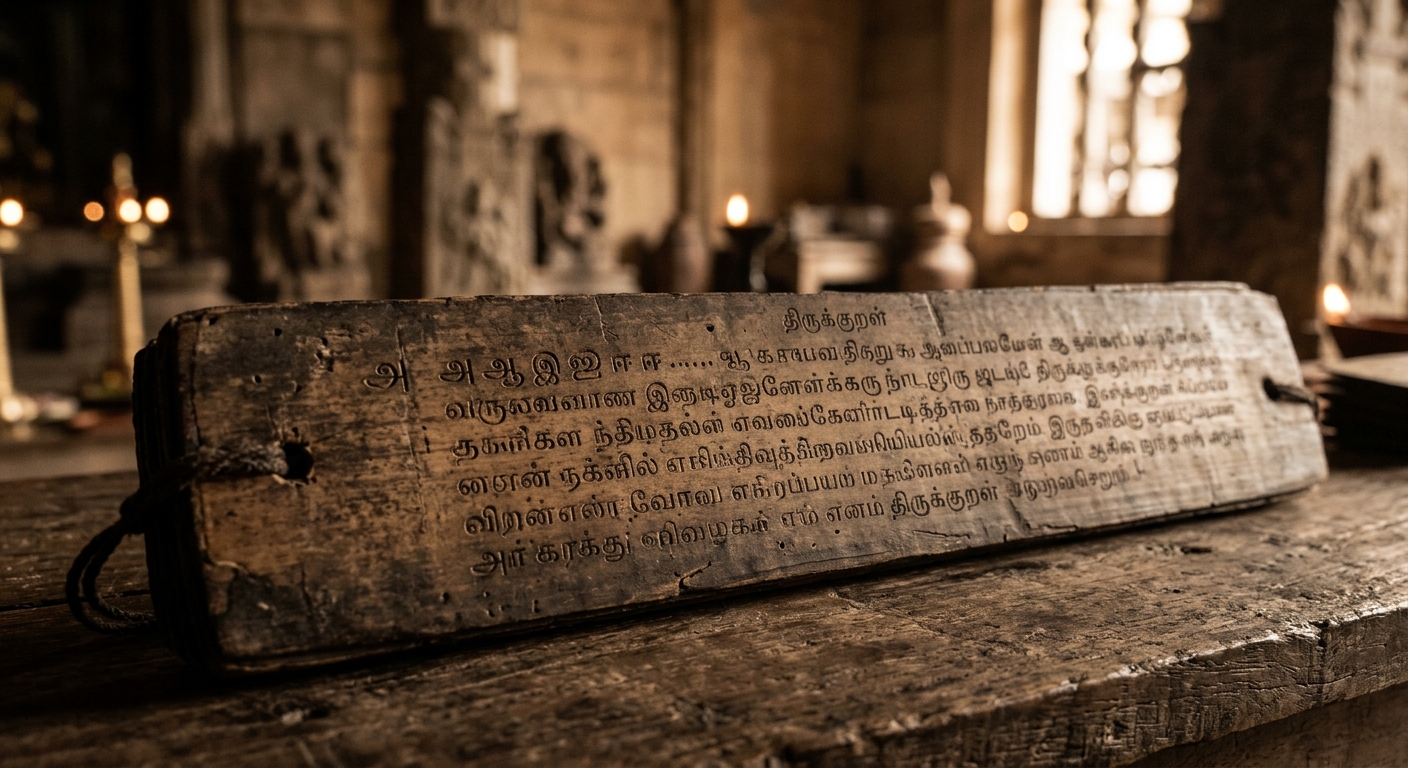
Nadi astrology is a tradition found in Tamil Nadu and a few other parts of India where practitioners claim to read your past, present and future from ancient palm-leaf manuscripts. The word "nadi" means "in search of" in Tamil. According to the tradition, thousands of years ago, sages wrote the life details of every person who would ever seek a reading on dried palm leaves. Your job is to find your leaf.
Here's how it works in practice: you visit a Nadi centre, usually in Tamil Nadu, and give your thumbprint. A reader then brings out bundles of palm leaves and reads names, parent names and birth details aloud. When one matches your details, the reader declares that leaf yours and proceeds to read what the sage wrote about your life. The tradition holds that only those destined to find their leaf will walk through the door.
This is fundamentally different from kundli-based Vedic astrology. Nadi astrology doesn't calculate planetary positions. It doesn't use your exact birth time or chart. It relies entirely on the idea that your life was pre-written and preserved on a physical leaf, waiting for you.
Kundli astrology, by contrast, is a mathematical system. We at RashiKundli calculate planetary positions using Swiss Ephemeris, plot them on a birth chart and interpret the patterns. The chart changes if your birth time changes by even a few minutes. Nadi astrology doesn't calculate anything—it claims to retrieve what was already written.
How Nadi Astrology Works
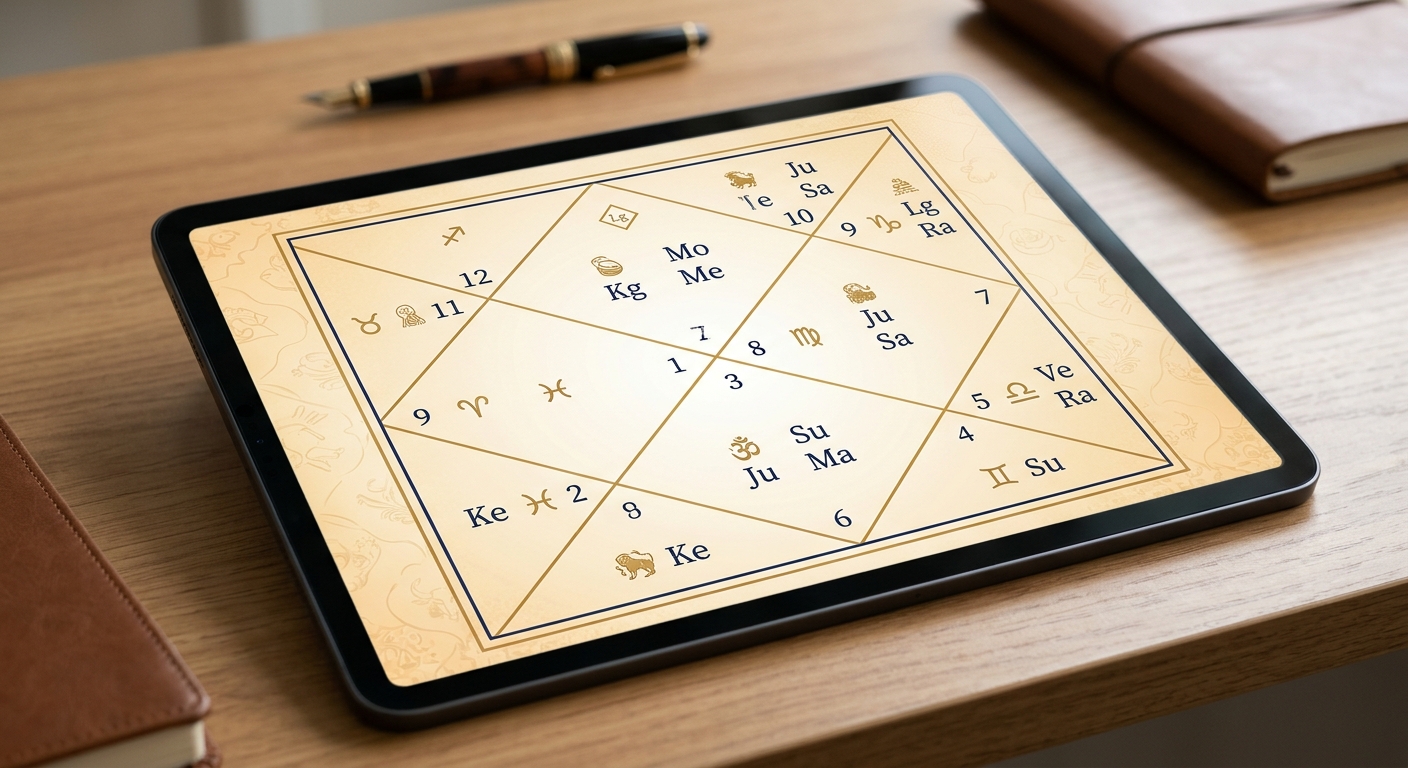
You don't need a birth chart for Nadi astrology. You need a thumbprint. Men give their right thumb, women their left. The centre takes your print and uses it to identify a bundle of leaves that might belong to you. Then the reader begins what's called "index matching"—reading names and details aloud to see if they match yours.
The process can take hours. Sometimes days. The reader might go through several bundles before finding a match. If no match is found, the tradition says your leaf isn't stored at that centre, or it's not your time to find it. Some seekers visit multiple centres across Tamil Nadu over many years.
Once a match is made, the reader translates the Tamil verses on the leaf into your language. The leaf is said to contain twelve chapters (kandams), each covering a different part of your life: career, marriage, children, health, spirituality. Not all chapters are read immediately. Some centres charge separately for each chapter or require additional rituals before revealing certain sections.
The tradition claims these leaves were written by sages like Agastya using a form of clairvoyance or divine knowledge. Scholars debate the age of the leaves and whether they're genuinely ancient or written more recently. The physical leaves degrade over time, so many centres now keep digital copies or transcriptions.
In Nadi astrology vs Vedic astrology, the fundamental difference is this: Vedic astrology uses your birth details to calculate a chart. Nadi astrology uses a thumbprint to retrieve a pre-written script.
How Kundli-Based Vedic Astrology Works
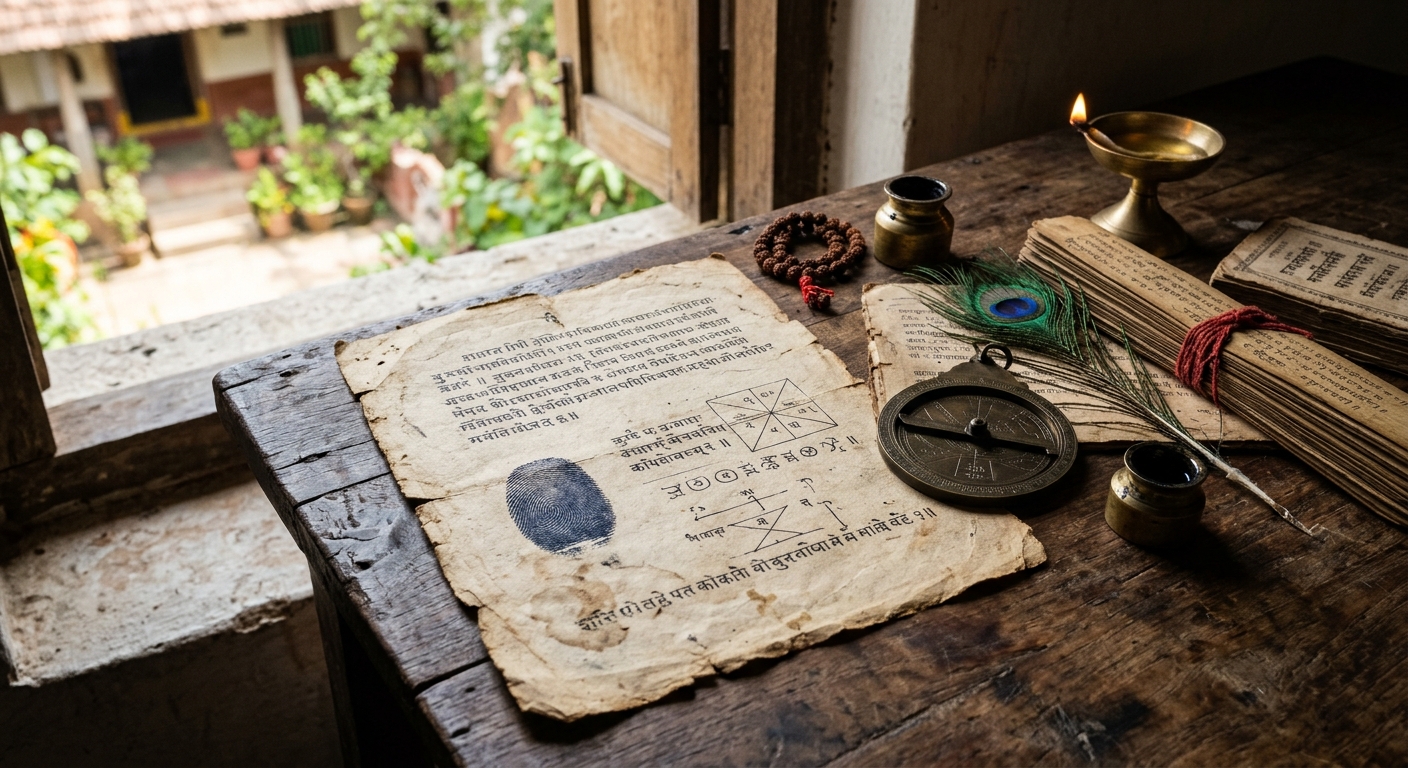
Kundli astrology is a calculation-first system. You give your birth date, exact time and place of birth. A practitioner—or a calculator like the one at RashiKundli's free birth chart tool—plots the positions of the Sun, Moon, planets, lagna (ascendant) and nakshatras at that moment. The result is your kundli.
The chart is precise. A birth time off by four minutes can shift your lagna to a different sign. A different lagna changes the house placements of every planet, which changes the interpretation entirely. That's why traditional Vedic astrologers spend so much time confirming birth times.
Once the chart is ready, the astrologer reads the relationships between planets, their house placements, aspects, dashas (planetary periods) and transits. The system is structured. Each planet governs certain life areas. Each house represents specific themes. The nakshatra adds emotional and karmic layers. Vimshottari dasha gives a timeline.
The interpretation is layered but systematic. There are rules: Saturn in the seventh can delay marriage. Jupiter in the first often brings optimism. Mars in the second or fourth or seventh or eighth or twelfth forms mangal dosha. The astrologer applies these rules to your chart and draws conclusions.
Kundli astrology doesn't claim your entire life was pre-written and stored in a leaf. It says the sky at your birth moment reflects your karmic blueprint. You still write the story. The chart shows the weather, not the script.
The Difference Between Nadi and Kundli Jyotish in Practice
Nadi astrology is rigid. The leaf says what it says. There's no recalculation, no second opinion, no adjusting for birth time uncertainty. If the leaf says you'll marry at 28, that's the reading. You can't check the math because there is no math.
Kundli astrology is transparent. You can see the chart. You can verify the planetary positions against Swiss Ephemeris or NASA data. If two astrologers give different readings, you can ask why. Often it's a difference in interpretation style, dasha system or ayanamsa. But the chart itself is checkable.
Nadi centres charge per chapter. Want to know about career? That's one fee. Marriage? Another. Remedies? Another still. The cost can add up quickly, and you're expected to perform rituals or pujas that the leaf prescribes—often at the same centre.
We at RashiKundli don't sell rituals. We don't require pujas to "activate" your chart. Your kundli is yours the moment you're born. The information is free. The interpretation is transparent. If a remedy is suggested, it's optional—never sold as a requirement.
The other practical difference: accessibility. Nadi astrology requires you to travel to Tamil Nadu or a handful of centres elsewhere. You can't do it online. Kundli astrology works anywhere. You can generate your chart in seconds and ask our AI astrologer by phone, video or AI.
Nadi leaf readings are also one-way. The reader tells you what the leaf says. You don't get to ask follow-up questions about specific transits or dashas. Kundli-based consultations are interactive. You can ask why Saturn is placed where it is, what happens during your Venus dasha, how a current transit affects your chart.
What Nadi Astrology Gets Right
Nadi astrology is compelling when it works. People report eerily accurate name matches, correct parent names, siblings' names and life events that no one could have guessed. When a reader pulls out a leaf and rattles off details you've never shared, it's hard to dismiss.
The tradition also offers closure. If the leaf says a difficult period will end at a certain age, that can bring hope. If it names a health issue you've been struggling with, the validation itself can feel healing—even if the remedy doesn't work.
For seekers who feel lost in life, the structure of Nadi astrology is comforting. The leaf says there's a plan. Someone wrote it down. You're not drifting—you're following a script. That's powerful, especially during uncertainty.
And to be fair, Nadi astrology doesn't ask you to understand astronomy or learn chart interpretation. You just show up. The system does the rest. For people intimidated by kundli astrology's complexity, that simplicity is appealing.
What Kundli Astrology Gets Right
Kundli astrology is transparent. You can learn it. You can verify it. You can check if your astrologer made a calculation error. That's not possible with a palm leaf written in Old Tamil that you can't read yourself.
The flexibility of kundli astrology is another strength. Charts evolve as you age. Dashas change. Transits shift. The reading you get at 25 won't be identical to the one at 40, because your chart is a living map, not a static script.
Kundli astrology also respects free will. Tradition holds that the chart shows inclinations and periods, not certainties. You're born with a Saturn placement, but how you respond to it—whether you buckle or build discipline—is yours to decide. Nadi astrology, by contrast, often presents life as pre-determined.
Another practical point: kundli astrology doesn't require travel or physical rituals. You don't need to visit a specific temple or perform a puja to unlock your chart. The chart is complete the moment it's calculated. That makes it accessible to anyone, anywhere.
And kundli astrology is cumulative. You can study one planet, then another. Learn about houses, then nakshatras, then dashas. Over time, you understand your own chart. You become literate in your own life map. Nadi astrology doesn't offer that. The leaf is read to you, not by you.
Can You Use Both?
Some people do. They generate their kundli for ongoing guidance and visit a Nadi centre once in their life out of curiosity. There's no theological conflict—both systems claim roots in ancient Indian tradition.
But practically, they don't overlap. Nadi astrology won't ask for your birth chart. Kundli astrology won't send you to find a palm leaf. They operate on entirely different premises.
If you're deciding between the two, ask yourself what you're looking for. Do you want a one-time reading that claims to know your whole life story? Nadi astrology offers that. Do you want a chart you can revisit, study and use to track transits and dashas over decades? Kundli astrology offers that.
Do you want transparency and the ability to verify the information? Go with kundli. Do you want the experience of a mystical retrieval process and the thrill of finding "your" leaf? Go with Nadi.
People have found comfort in Nadi readings, while others have felt manipulated by upsells and ritual fees. Some people cannot make sense of their kundli until they work with a skilled astrologer, while others learn to read their own chart and never look back.
Neither system is a magic answer. Both require discernment. And both, ultimately, are tools—not scriptures.
The Role of Calculation vs Intuition
Here's the thing: kundli astrology is a science. It uses math, astronomy, planetary cycles. You can program a computer to generate a kundli, and if the input data is correct, the chart will be accurate. That's why we use Swiss Ephemeris—it's the same data NASA uses.
Nadi astrology is not a science in that sense. It's a retrieval tradition. The accuracy depends entirely on whether the leaf is genuine, whether the matching process is honest, and whether the translation is accurate. You can't verify any of those steps yourself.
That doesn't make Nadi astrology fake. It makes it faith-based. You're trusting the process, the reader, the leaves and the tradition. Kundli astrology asks for less trust and more participation. You can fact-check the calculation. You can learn the rules. You can argue with the interpretation.
Some people prefer the mysticism. Others prefer the logic. Both are valid preferences. But if you're someone who needs to understand how the system works before you believe it, kundli astrology will make more sense. If you're drawn to the idea of a pre-written destiny waiting on a dusty shelf in Tamil Nadu, Nadi astrology will call to you.
What RashiKundli Recommends
We calculate kundlis. We don't read Nadi leaves. So we're biased. But here's our take: if you want astrology you can use daily, weekly and across your life—kundli astrology is the answer. It's repeatable, checkable and adaptable.
If you're curious about Nadi astrology, go see it for yourself. But go with realistic expectations. Don't assume the leaf is ancient. Don't assume the reading is infallible. And don't agree to expensive rituals unless you genuinely want to perform them. The leaf should guide you, not guilt you.
Most importantly, don't let any system—Nadi or kundli—override your own judgment. Astrology is a mirror, not a manual. It reflects patterns, not orders. If a Nadi leaf says you'll face a crisis at 32, prepare wisely but don't freeze your life waiting for disaster. If a chart like this shows Saturn in the seventh, understand the theme but don't write off marriage.
The stars guide, your karma decides.